Sociography: The Marienthal story
in: Austria today. Quarterly review of trends and events (Vienna [Wien]), 4. Bd., Nr. 3 (Juli 1978), S. 55–57.
Die Veröffentlichung auf dieser Website erfolgt mit freundlicher Genehmigung von Michael Freund, Wien. Beachten Sie das Copyright!
55
SOCIOGRAPHY:
THE MARIENTHAL STORY
by Michael Freund
Marienthal shares the characteristics of industrial settlements whose history is tied to the fate of a large company. During the Great Depression unemployment was widespread in such towns. Marienthal, however, became much better known than its anonymous counterparts. Social scientists of various disciplines and from different parts of the world are familiar with its name. How come?
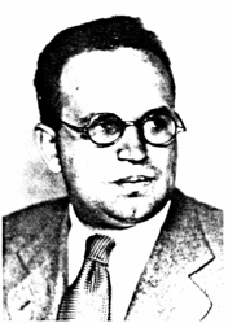
In the 1920’s, the Austrian Social-Democrats were hoping for a peaceful, i.e. electoral road to socialism, and undertook various political measures concerning housing, health, education, social welfare and labour. Young party activists and scholars tried to assess the impact of such measures on the people affected and on the electorate in general. This study shared the anti-metaphysical spirit of the logical positivists who later became known as the Vienna Circle. Paul F. Lazarsfeld, a research assistant in psychology, was among those who were less concerned with a dialectical theory of history than with immediate and, as he would add as a social scientist, quantifiable facts. He intended to study empirically and statistically the links between political, social and psychological events.
In 1927 Lazarsfeld, then 26 years old, was able to give this concern an institutional basis. He was made director of the Wirtschaftspsychologische Forschungsstelle (Research Centre for Economic Psychology, a term broadly connoting the application of psychology to social and economic problems) at the Vienna University department of psychology. For a few years the research centre made marketing surveys as well as sociological studies on voting, family structures, authority patterns and the like.
In 1930, the Social-Democrat Otto Bauer suggested that the centre devote itself to a study of unemployment. A location – Marienthal – was soon found, and in 1931–32 the Forschungsstelle carried out an intensive survey involving all 478 families of the factory housing complex (M. Jahoda, P.F. Lazarsfeld, and H. Zeisel, »Die Arbeitslosen von Marienthal: Ein soziographischer Versuch – Unemployment in Marienthal; a sociographic experiment«, Leipzig: Hirzel, 1933).
The study was unusual and innovative in several respects. Its explicit aim was to bridge the gap between statistical counts and the subjective impressions of social commentaries. Therefore objective observations and introspective reports were included; case studies were combined with statistics; historical information was added to the material dealing with the present; and the questionnaires were supplemented with »natural data«, such as library reports, to indicate any declining interest in reading. (Such procedures became later known in the social sciences as »unobtrusive measures«.)
All in all, there emerged a portrait of a community living under great stress, in which the majority were losing a sense of involvement, of perspective, even of time. Resistance to unemployment as a »state of mind« was slowly breaking down.
Despite a methodological allegiance to positivism, the researchers arrived at generalizing formulae such as »the tired community« and »shrinkage of
56
psychological life space«. Synthetic generalizations distinguished the study from most American surveys of the time (European sociology was not concerned with systematic surveys); the few exceptions, notably Middletown and Yankee City, did not take an acute social problem as their starting point but rather the notion of an »average town«.
Marienthal
A section of Gramatneusiedl, a small village 24 km south-east of Vienna, Marienthal came into being in the 1830’s after the banker Hermann Todesko [recte Todesco; Anm. R.M.] founded a textile mill there. Housing units were added. The Marienthal-Trumauer A. G., the largest company of its kind during the days of the Monarchy, went bankrupt in 1929, leaving more than threefourths of the workers (about 370 families) without employment. After World War II, the factory was set up again; in the early ’sixties it was replaced by a small chemical plant. Today it is the home of some 800 local factory workers, commuters and retired people.
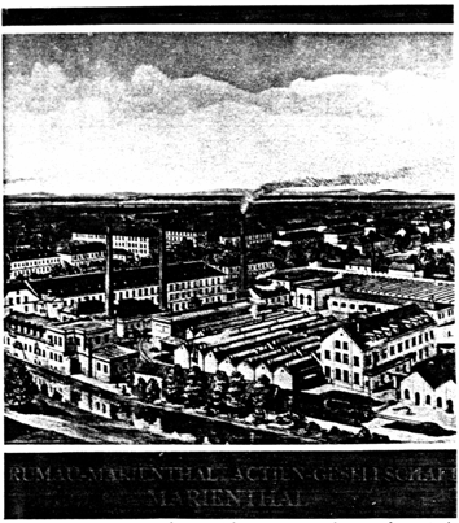
Marienthal-Trumauer A.G., the country’s largest spinning and weaving factory, in the 1870’s [recte 1914; Anm. R.M.]
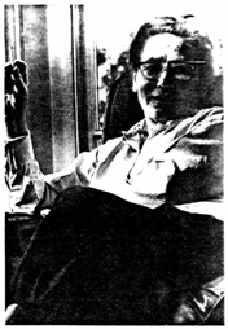
The Marienthal study, then, was to become a milestone in sociological research, but in ways other than anticipated: in Nazi Germany the book was banned soon after publication. The Corporate State in Austria put an end to the period of reform and, incidentally, to an act of aid to Marienthal: Quakers who had heard of the study came to help start a farming cooperative, but did not return after the political events of 1934. Lazarsfeld was already in the United States, Marie Jahoda and Hans Zeisel followed soon after. The latter is now a professor of sociology at the University of Chicago. Jahoda continued working as a psychologist in the States and is now teaching at the University of Sussex in England. Lazarsfeld died in 1976. He had propagated the idea of applied social research and started the first major institute of this kind at Columbia University. The »Forschungsstelle« and Marienthal were the model for its organization and projects. Thus the village was soon bet-
57
ter known across the ocean than back ho me.
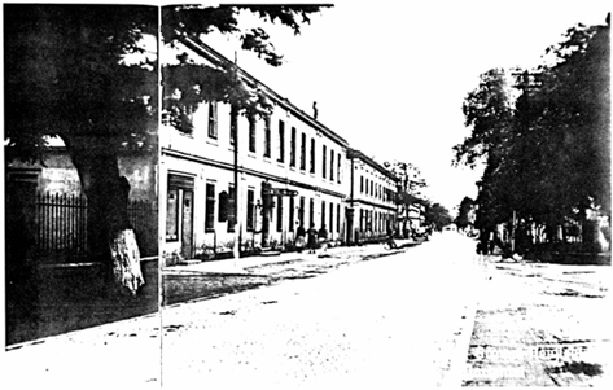
Company housing in Marienthal.
In Germany and Austria, the survey was only revived after the monograph had been re-printed in 1960 (paperback edition: 1975). Marienthal has become part of the sociology curricula at Austrian universities. Due homage, so to speak, has thus been paid, but the study now also risks getting lost by being set upon a lofty pedestal for »classics«. For one thing, it is primarily viewed as a point in time past, with little reference to the previous and subsequent history of the village. Because of the political situation, the study could not have any policy impact – in itself a sobering result. But the problem investigated persisted and left its mark on the village. Today Marienthal stands paradigmatically for commuter-type towns still suffering from the long-range consequences of a loss of labour-intensive industry.
A team of which the present author is part is working on an investigation of Marienthal today which is to include a documentary film and a survey. A second potential problem with the reception of the study lies in its reduction to sociological methodology. Lazarsfeld himself, it is true, coined the notion of the »methodological equivalence of socialist voting and the buying of soap«; today’s survey researchers are indeed busy polling images of parties and soaps alike until they appear less and less distinguishable. One should realize, though, that the legacy of the Marienthal study lies in the capacity of its authors to make conceptual distinctions between different objects and levels of analysis, and to embed their reasoning in an a priori theoretical and political framework.